 Written by
  Edited by
  Edited by

A social media calendar for financial advisors is a schedule for planning what to post, where to post it and when it will go live. To build one, choose a format your team can use, set a posting schedule and record each post’s topic, platform, content type and publication date. You can also track engagement and leave time to review posts for accuracy and compliance before publishing.
SmartAsset’s Advisor Marketing Platform (AMP) offers financial advisors services like client lead generation, automated marketing and more. Learn about SmartAsset AMP today.
How to Create a Social Media Calendar for Financial Advisors
Relying on a social media calendar and tracking key performance indicators can help you determine the best days or times to post, and what type of content generates the most engagement. You can also use your calendar to map out a content plan and keep track of what you’re posting or reposting to the platforms you’re active on. With that in mind, here are some common tips to build a social media calendar for financial services:
Select the Right Format
There are several ways to create a social media calendar for your advisory business. The options include:
- Creating your schedule with a regular paper calendar or datebook
- Using a spreadsheet to track your social media content
- Creating a digital calendar using a tool like Canva or Goodnotes
- Utilizing a social media calendar app or tool
- Using a downloadable or digital template
When choosing a method, consider how accessible you need your calendar to be. If you have multiple team members who need to be able to view the calendar, for example, then it could make more sense to use a collaborative digital tool versus a physical paper calendar.
Categorize Content by Type
Social media content for advisors can take different forms. You might post images, videos, polls or quizzes, pose a short question to your audience or create a series of connected posts that inform on a specific topic. Longer-form content may be part of a thought leadership strategy if you’re focused on building your credibility and authority.
Developing a category or classification system for your content makes it easier to inject some variety into your posts, and see what you posted last and what’s next at a glance. Color-coding categories provides visual direction and allows you to see which types of content you’re posting most or least often.
Add Content Details
In addition to the content format, your social media calendar should include some relevant details about what you plan to post. That includes the content topic or post title, which platform(s) you’ll share it on, the date and time the post is scheduled to go live and any hashtags or SEO keywords you plan to include.
If you’re using an online social media calendar template that allows linking, you may also include a link to any files you plan to include with the post, such as an image or video. This also allows you to check for broken links in one place, rather than sifting through individual posts.
Create a Posting Schedule
How often you show up on social media can make a difference in your efforts to build a following and keep those followers engaged. In terms of the typical posting frequency, HubSpot found that 31% of businesses post multiple times per week, with just under 20% posting once daily. A majority, 64%, post less than once per day while 19% post multiple times per day. 1
Your posting schedule should reflect your target audience’s social media habits and your ability to crank out new content. Artificial intelligence tools can assist with social media content creation; 94% of marketers report using AI in their workflows, according to HubSpot’s 2026 Social Media Marketing Report. The most common uses include ideation and brainstorming (42.9%), generating captions or short-form text (41.5%), image generation (38.35%) and image editing (34.78%). 2
Note that if you plan to use AI to streamline social media content production, any content you create should be subjected to a thorough human review. This quality check is essential for spotting any errors or typos, ensuring that content aligns with your brand voice and maintaining compliance.

Client Acquisition Simplified: For RIAs
- Ideal for RIAs looking to scale.
- Validated referrals to help build your pipeline efficiently.
- Save time + optimize your close rate with high-touch, pre-built campaigns.

CFP®, CEO
Joe Anderson
Pure Financial Advisors
We have seen a remarkable return on investment and comparatively low client acquisition costs even as we’ve multiplied our spend over the years.
Pure Financial Advisors reports $1B in new AUM from SmartAsset investor referrals.
Social Media Calendar for Financial Advisors Template
Having a template to use as a guide can help you shape your social media content calendar in less time. If you’re using a digital template, you can easily duplicate the template to update it for each new week or month.
Here’s an example of one way you could visualize your social media calendar using a weekly posting format:
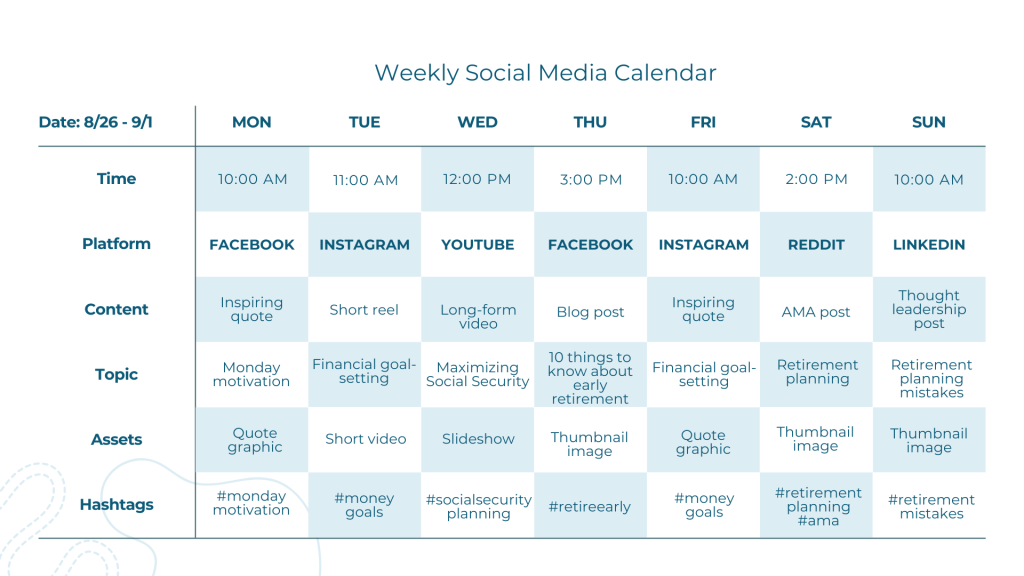
As you can see, there’s room to record your social media content for the week, including the time you’ll post, where the content is going, what type of content you’re sharing and any relevant details.
Again, this doesn’t have to be complicated. The goal is to simply create an easy-to-follow format for tracking your social media content.
Outsource Your RIA Marketing
Automate your marketing with a proven system. Automated outreach, nurture campaigns and more.

Social Media Content Ideas for Financial Advisors

Creating a social media calendar can go a long way in helping you get organized, but you need something to put on it. If you’re stuck for ideas on how to promote your advisory business, here are some types of social media content you can consider:
- Share your favorite personal finance tip and why you think it’s something your followers should know.
- Tell a personal story of a money mistake you once made and how you help your clients to ensure they don’t fall into the same trap.
- Share an inspiring or motivational money quote to get your followers excited about their financial situation.
- Highlight a client success story or case study that demonstrates how you helped them reach their goals.
- Share your thoughts on a trending finance topic and what you think your clients should know about it. For example, you might dive into what’s happening with interest rates or break down TikTok money trends like underconsumption core.
- Start a Q&A or AMA (ask me anything) thread and invite your followers to ask you questions about a specific topic or financial planning in general.
- Share a news article that you found helpful or interesting and ask your followers to share their thoughts in the comments.
- Provide followers with timely updates that can impact them directly, such as changes to the tax code or rate hikes/cuts.
- Boost engagement by posting a poll or survey and asking followers to share their responses.
- Share content on the same topic in different formats across platforms. For example, you might share a blog post on Facebook, make a reel about it for Instagram, and create a longer-form video for YouTube.
- Share a list of your favorite personal finance books, blogs or podcasts and ask your followers what’s on their reading, watching and listening lists.
- Take time to shine a spotlight on one of your employees and the valuable contributions they make in serving clients.
Those are just a few ideas you could use to connect with your followers. The best social media content strategy focuses on creating content that’s relevant to your audience and that’s designed to engage or inspire them in some way.
And don’t forget to include a call to action in your posts so your followers know what to do next. For example, if you’re trying to grow your email list, you might share a blurb about your lead magnet and a CTA that tells your readers how and where to download it.
If you’re struggling to gain traction on social media or simply want to explore new sources of prospects, consider SmartAsset Advisor Marketing Platform (AMP). This holistic marketing platform connects advisors with prospective investors and provides them with automated marketing tools to nurture relationships via email and text campaigns. Schedule a demo to learn more.
Frequently Asked Questions (FAQs)
Do Financial Advisors Need a Social Media Calendar?
Financial advisors don’t need a social media calendar, but there are some benefits to having one. A calendar makes it easier to track social media content, including when and where it’s posted and the topic covered. If you tend to repurpose or repost content, a calendar can help you ensure that you’re spacing out posts appropriately.
What’s the Best Social Media Calendar Tool for Financial Advisors?
There’s no one social media calendar tool that’s better than another. Some advisors may prefer an old-school pen-and-paper method, while others look to digital calendar tools to do the job. It’s more important to choose a method for tracking social media content that works for you.
What Do Financial Advisors Need to Know About Social Media Compliance?
Compliance is an important consideration for financial advisors. The SEC’s marketing rule restricts the kinds of statements advisors can make when marketing their firms. There are also rules regarding the use of client testimonials to promote your firm. Familiarizing yourself with compliance requirements for social media can help you avoid potential violations of SEC guidelines.
Bottom Line

A good marketing plan includes social media, and a calendar can help you stay on top of your content. The template included here is just one example of how you might create a social media calendar to track your firm’s posts.
Tips for Growing Your Advisory Business
- Marketing is essential for growth. After all, you can’t rely on word of mouth and referrals alone. If you’re struggling to be consistent or want to streamline your efforts, that’s where we can potentially help. SmartAsset AMP (Advisor Marketing Platform) is a holistic marketing service financial advisors can use for client lead generation and automated marketing. Sign up for a free demo to explore how SmartAsset AMP can help you expand your practice’s marketing operation. Get started today.
- Which social media channels make the most sense for marketing? The answer can depend largely on how well you know your target client base. Facebook, YouTube, Instagram and TikTok are some of the most popular social media channels. However, some are more heavily favored among certain demographics than others. Understanding who your ideal client is and where they spend time online can help you pinpoint which channels it makes the most sense to be active on.
Photo credit: ©iStock/VioletaStoimenova, ©Rebecca Lake, ©iStock/David Gyung, ©iStock/VioletaStoimenova
Article Sources
All articles are reviewed and updated by SmartAsset’s fact-checkers for accuracy. Visit our Editorial Policy for more details on our overall journalistic standards.
- Pennings, Erin. “How Often to Post on Social Media for Business? A HubSpot Experiment.” HubSpot, https://blog.hubspot.com/marketing/how-frequently-should-i-publish-on-social-media#should-i-publish-more-or-less-often-on-social-media.
- Sukhraj, Ramona. HubSpot’s 2026 Social Media Marketing Report: Data from 1100+ Global Marketers. HubSpot, https://blog.hubspot.com/marketing/hubspot-blog-social-media-marketing-report.