 Written by
  Edited by
We are a dual-income couple in our mid-50s with over $2 million in our 401(k)s. Should we “sacrifice” the pre-tax benefit and switch to Roth contributions at work?
-Wendy
Like most tax-related questions, the answer is “it depends.” Based on your situation, switching contributions to a Roth 401(k) could make sense for a few key reasons, including tax diversity and tax-free growth. However, there may be additional factors that make sticking with a traditional 401(k) and opening a Roth IRA on the side more desirable.
You’ll also want to consider the pay now vs. pay later tax impact of your choice. A lot of factors and assumptions (like future tax rates) go into these calculations. Still, it’s worth trying to figure out which path will save you the most in taxes over your lifetime.
Because there’s no straightforward, one-size-fits-all answer here, it makes sense to discuss this with a financial advisor or tax pro. They’ll have advanced modeling programs that can help you see the different tax implications of sticking with a traditional 401(k) or switching to a Roth account. (And if you’re interested in working with a financial advisor, this tool can help you match with one.)
What Is a Roth 401(k)?
More employers than ever are offering Roth 401(k) plans as part of their benefits packages. These hybrid accounts combine features of traditional 401(k) plans and Roth IRAs, giving you a workplace retirement option with special tax-free growth features. However, these plans haven’t fully caught on yet. The majority of the money in employee retirement accounts still sits in traditional 401(k)s, mostly because people generally prefer the “pay less tax right now” model.
Unlike a regular 401(k), contributions to a Roth 401(k) won’t lower your current tax bill. These contributions are made with after-tax dollars, so you pay taxes upfront in exchange for a huge benefit down the road tax-free growth. If you follow the rules, you won’t have to pay any tax on the earnings inside the account when you withdraw them.
Moving all or a portion of your contributions to a Roth 401(k) also gives you greater tax diversity. If you opt for a hybrid approach, some of your money will be taxable when you withdraw it (traditional), while some will be tax-free (Roth). That gives you more flexibility with future tax planning. (A financial advisor can help you determine whether a Roth 401(k) is right for you.)
Pros and Cons of a Roth 401(k)

Roth 401(k)s come with benefits and drawbacks, just like any other type of retirement account. For most people, the pros outnumber the cons. But the most significant drawback, which is a bigger tax bill today, could outweigh those benefits.
First, let’s look at the benefits of Roth 401(k) plans:
- Tax-free earnings growth (in most cases)
- No required minimum distributions (RMDs) for people turning 73 after Dec. 31, 2023, thanks to the SECURE 2.0 Act
- No income restrictions on contributions
- Tax-free distributions on the money you properly withdraw
- Lower adjusted gross income (AGI) in the future, which can increase your eligibility for things like tax-free Social Security benefits
Now, for the drawbacks:
- No current tax break
- Higher current AGI, which can affect your eligibility for things like the child tax credit
Additionally, there is one tricky feature of Roth 401(k)s worth noting: matching contributions. Historically, matching contributions for Roth 401(k)s have been made on a pre-tax basis, which means you wouldn’t pay any current income taxes on the match. However, you would be taxed on that money as well as any earnings when you withdraw it in the future.
That said, the SECURE 2.0 Act gives employers a new option to put those matching contributions into the Roth 401(k) account, simplifying finances for their employees. Check with your employer to see how they handle Roth 401(k) matches. (And if you need help planning for retirement, this tool can help you match with a financial advisor.)
Roth 401(k) vs. Traditional 401(k)
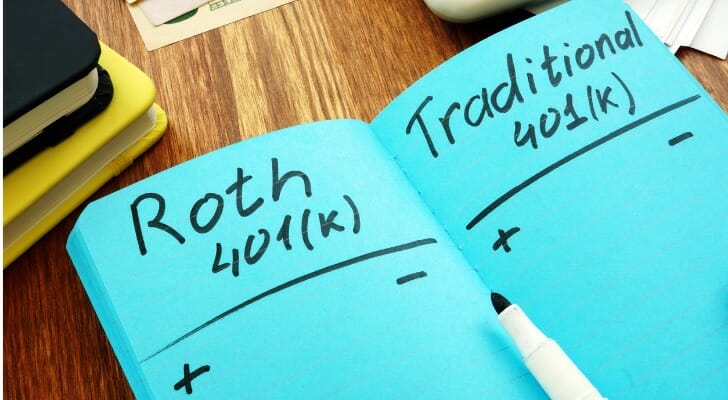
Now that you understand the pros and cons of Roth 401(k)s, let’s look at how they compare to traditional 401(k) accounts:
- Tax timing: With a traditional 401(k) plan, you contribute pre-tax dollars, so the money you put in doesn’t count as taxable income now. Instead, you’ll pay income taxes when you take the money out. With a Roth 401(k), you contribute post-tax dollars, and the money you put in counts as current taxable income. When you withdraw those contributions and their related earnings, they won’t be included in your income and you won’t pay tax on them (if the money is withdrawn properly).
- Early withdrawals: With a traditional 401(k), distributions taken before age 59 ½ may trigger 10% early withdrawal penalties on the full amount withdrawn. With a Roth 401(k), withdrawals are pro-rated to include contributions and earnings, and that 10% penalty gets applied only to the earnings portion.
- RMDs: You must take RMDs from traditional 401(k) accounts once you reach age 73 (75 for people born in 1960 or later). However, as of 2024, you do not have to take RMDs from Roth 401(k)s. Withdrawals will not be required until after the account owner’s death.
Plan ahead for taxes and cash flow with SmartAsset’s RMD Calculator. Get a quick estimate of your required withdrawals so you can make informed financial decisions.
Roth 401(k) vs. Roth IRA
While they share some important similarities, Roth IRAs and Roth 401(k)s have some equally important differences.
For one, Roth IRAs have strict income limits, which prevent many people from contributing. For 2025, individuals who earn more than $165,000, or couples earning more than $246,000, can’t contribute to Roth IRAs. Anyone can contribute to a Roth 401(k) regardless of income.
Roth IRAs also have significantly lower contribution limits compared to Roth 401(k)s. The maximum IRA contribution for 2025 is just $7,000, or $8,000 if you’re 50 or older. The maximum contribution for a Roth 401(k), in comparison, is $23,500, or $31,000 if you’re 50 or older. Plus, Roth 401(k)s have the potential for employer matches, which are not available for Roth IRAs.
If you need help picking between retirement accounts, consider speaking with a financial advisor.
Next Steps
There’s a lot to consider when choosing between traditional and Roth 401(k) accounts. To make the best possible decision based on your unique financial situation, talk to your financial advisor or tax professional. They can help you weigh the pros and cons of switching over to a Roth and better understand how the plan stacks up against other retirement account options.
Tips for Finding a Financial Advisor
- If you have questions specific to your gifting and tax situation, a financial advisor can help. Finding a financial advisor doesn’t have to be hard. SmartAsset’s free tool matches you with up to three vetted financial advisors who serve your area, and you can interview your advisor matches at no cost to decide which one is right for you. If you’re ready to find an advisor who can help you achieve your financial goals, get started now.
- Consider a few advisors before settling on one. It’s important to make sure you find someone you trust to manage your money. As you consider your options, these are the questions you should ask an advisor to ensure you make the right choice.
Michele Cagan, CPA, is a SmartAsset financial planning columnist and answers reader questions on personal finance and tax topics. Got a question you’d like answered? Email AskAnAdvisor@smartasset.com and your question may be answered in a future column.
Please note that Michele is not a participant in SmartAsset AMP, and she has been compensated for this article.
Photo credit: ©iStock.com/courtneyk, ©iStock.com/designer491