 Written by
  Edited by

For better or worse, the world runs on oil, natural gas and its derivatives, collectively called petroleum. The rise and fall of petroleum follows economic trend lines to a degree absent from most other commodities. When the economy is strong, the world needs lots of energy. But when cars and factories slow down, they burn less fuel, and oil supplies start building at tank farms. For this reason, investing in oil is often seen as a good proxy for investing in the economy as a whole. Here’s how you can do so.
Before investing in petroleum, consider working with a financial advisor to see if there are other commodities that would be a good fit for your portfolio.
Oil Industry Stocks
The easiest way to invest in oil is to directly invest in the companies that produce it. By investing in shares of publicly traded oil companies, such as Exxon Mobil or Chevron, you can sink your money into the profits and losses of the industry.
However, it’s important to note that by purchasing specific stocks, you’ll invest in the companies, not necessarily the asset they produce. This can be a good thing, since a well-run company can thrive even when its asset prices dip, but you will be investing in the performance and management of that company rather than the price of oil itself.
Oil-Related Funds
Mutual funds and exchange-traded funds (ETFs) are baskets of assets built around an organizing theme. In the case of oil funds, you can purchase two main kinds.
First, some mutual funds and ETFs are indexed to the price of oil or natural gas, or to one of their derivatives. This means that the fund has a basket of assets designed to track the price of specific petroleum, in many cases the commodity itself. Another option is to invest in a fund that is built out of oil companies and other related assets. Here, the price of the fund does not follow a specific index but rather attempts to reflect the overall performance of the fossil fuel industry.
For most investors, mutual funds and ETFs are by far the best way to invest in oil. In general, funds should make up the bulk of an average retail investor’s portfolio given their potential for overall stability and long-term growth. Investing in a fund built around either oil prices or the oil industry is a good way for investors to gain exposure to this sector without the risks involved with more speculative assets.
Derivatives (Futures and Options)
Derivatives are financial products that take their value from some underlying asset. Futures contracts and options contracts are the most common forms on the market, with each taking its value from the product they represent. Most futures and many options are based on commodities, and this is the best way to directly invest in the price of oil.
Oil futures allow you to invest in oil directly, and the same goes for futures in other kinds of petroleum. When you take a long position futures contract in oil, you agree to buy a set number of barrels for an agreed-upon price at the agreed-upon date. With a short position futures contract, you agree to do the same thing in reverse, selling a set number of barrels for an agreed-upon price. This allows you to profit off changing prices.
For example, say you take a futures contract to buy 1,000 barrels of oil for $50 per barrel on June 1. If the price of oil goes up to $60 per barrel by June 1, your contract will let you buy oil for $10 per barrel less than it’s worth.
When you buy a standard futures contract, you literally purchase a quantity of the asset in question. So, for example, a standard futures contract for 1,000 barrels of oil at $50 per barrel means at the end of that contract, you will receive 1,000 barrels of oil and be expected to pay $50 for each. Most investors take what’s known as a “cash settlement” contract, however, which resolves the contract based on what it’s worth with no product changing hands.
Options contracts give you similar exposure. The difference is that if a futures contract closes in an unprofitable position, you are expected to pay the difference between your contract price and the asset price. In an options contract, you can choose not to execute the contract if it ends unprofitably for you. In exchange, options contracts cost money to open, whereas futures contracts generally don’t.
Derivatives are the best way to gain direct exposure to petroleum prices because you literally agree to buy and sell barrels of oil. However, investors should be extremely cautious with this asset class. Derivatives are highly volatile. Options are sophisticated products that can be more costly than they seem, and futures contracts can end up triggering significant losses.
Related Industries
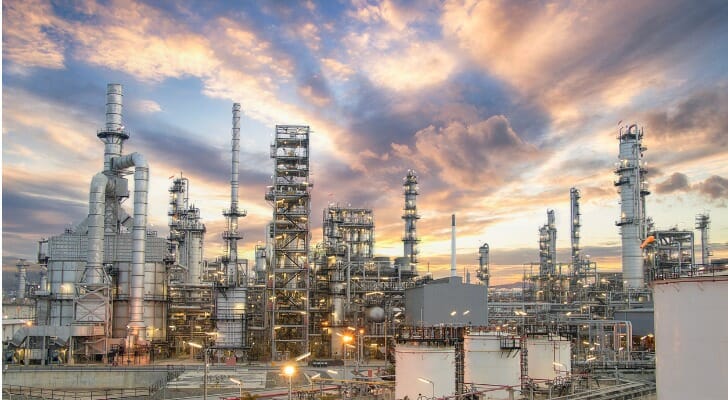
Finally, investors who would like peripheral exposure to the oil industry can seek out industries that are related to this asset.
Crude oil is one of the most versatile products in the world. While it is true that modern society runs off the energy produced by burning this commodity, that misses the sheer volume of physical products that it contributes to (either in whole or in part). Plastics, for example, are made out of natural gas, another form of petroleum. So are many fertilizers. Asphalt and various construction products are also based on oil, as are a number of chemical products. And, of course, the travel industry is directly influenced by the price of jet fuel. As mentioned above, all these are types of petroleum (sometimes also called hydrocarbons).
Investing in companies whose products depend on oil can be a solid way to partially invest in oil. For example, buying stock in a chemical or plastics manufacturer will expose you to a company likely to do well when oil prices dip. Investing in this way only allows you to buy into the market, but it also can be a good counter-cyclical investment to offset any direct investments you have made. The same goes for companies that sell drilling and production services, make and lay pipelines and move the product in ships.
Global Politics, Sanctions and Supply Risk in 2026
Oil prices in 2026 will move less on company results and more on global political events. Sanctions policy, trade access and supply disruptions often affect prices before any physical change in production occurs. For investors, oil increasingly reflects macro risk rather than traditional sector fundamentals.
Sanctions remain a major driver. Countries with large reserves but limited exports can shift market expectations even when output stays flat. Policy signals alone can affect pricing, especially when global spare capacity is thin.
Venezuela illustrates this dynamic. The U.S. capture of Nicolás Maduro in 2026 created uncertainty around sanctions enforcement, export permissions and future investment conditions. Markets reacted to the political change despite no immediate increase in production, reflecting uncertainty rather than supply growth.
From an investment perspective, Venezuela’s situation introduces both potential supply risk and longer term questions about access. Years of underinvestment, infrastructure damage and operational constraints limit near-term output regardless of political change. Any future impact depends on regulatory clarity, capital availability and operational recovery timelines.
OPEC+ decisions continue to influence price levels. Production targets, compliance signals and coordinated adjustments shape expectations, especially when markets are sensitive to small supply changes. Announcements can matter as much as actual barrels.
Shipping and logistics risks are another factor affecting pricing. Disruptions in transit routes, higher insurance costs and regional conflicts can add risk premiums unrelated to company earnings or demand trends.
For investors in 2026, oil exposure requires attention to geopolitics alongside financial metrics. Sanctions policy, political transitions and supply access now play a larger role in shaping price behavior than traditional growth assumptions.
Bottom Line
Oil is closely tied with the overall economy, so much so that many people consider it essentially a proxy for the national, and even international, economy. While you could invest in oil directly with futures and options contracts, there are many other ways to invest in the oil markets, some of which are far less risky than futures contracts.
Keep in mind that the oil industry is varied, with investable assets spread across its upstream, downstream, refining and marketing and transportation sectors. Some securities are better suited to one or more of these sectors than others. And, of course, what makes sense for your portfolio depends on your specific goals and preferences.
Tips on Investing
- Like any asset, oil might be the right investment for your portfolio, or it might not. It all depends on your overall strategy and your long-term goals. Consider working with a financial advisor for a full understanding of your situation. Finding a financial advisor doesn’t have to be hard. SmartAsset’s free tool matches you with vetted financial advisors who serve your area, and you can interview your advisor matches at no cost to decide which one is right for you. If you’re ready to find an advisor who can help you achieve your financial goals, get started now.
- Once you’ve decided to invest in commodities, you’ll have to decide how much of your investment portfolio should be comprised of commodities. Periodically, you’ll have to rebalance your assets over the course of your investing time frame to make sure your investments are allocated as you intend. One of the simplest ways to do this is to use an asset allocation calculator.
Photo credit: ©iStock.com/james, ©iStock.com/Rangsarit Chaiyakun, ©iStock.com/spooh