 Written by
 Edited by
 Edited by

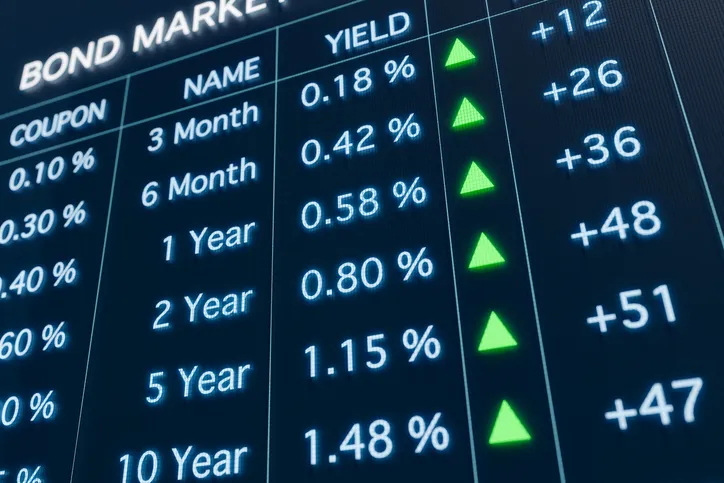
A bond’s maturity tells you how long you may wait to get your principal back, and that timeline can have a major effect on risk. Short-term bonds generally experience smaller price swings when interest rates change. Longer-term bonds may offer higher yields, but they are typically more sensitive to rising rates. The better fit depends largely on when you’ll need the money and how much price movement you can tolerate along the way.
A financial advisor can help you choose the right investment strategy to help you reach your own individual goals.
What Separates Short-Term and Long-Term Bonds
Bond maturities can range from a few weeks to several decades. However, what is short-term versus long-term can vary across bond types and funds. Regardless, the same basic maturity trade-offs apply to Treasurys, municipal bonds and corporate bonds.
| Bond Category | Typical Maturity | Common Examples | General Trade-Off |
|---|---|---|---|
| Short term | Roughly 1-3 years or less | Treasury bills, short corporate bonds | More price stability, more reinvestment risk |
| Intermediate | About 4-10 years | Treasury notes, corporate and municipal bonds | Middle ground |
| Long term | More than 10 years | 20- and 30-year Treasurys, long corporate bonds | Greater rate sensitivity, potentially higher yield |
Note that Treasurys use slightly different labels. Bills mature in up to 52 weeks, while notes generally mature within 10 years. Meanwhile, Treasury bonds typically have longer maturities.
How Interest Rate Risk Differs
Interest rates and fixed-rate bond prices generally move in opposite directions. If new bonds begin paying higher rates, an older bond paying a lower rate becomes less attractive and its market price generally falls. Longer maturities tend to amplify that risk.
Duration can give you a rough estimate of how sensitive a bond or bond fund may be to rate changes. A common rule of thumb is that the price changes by roughly the duration, represented as a percentage, for every one-percentage-point move in rates, in the opposite direction.
For example, suppose you own $10,000 of bonds with a duration of two years. A one-point increase in rates could imply an estimated decline of about $200 ($10,000 × 2%).
With a 15-year duration, the estimated decline would be much larger, roughly $1,500 ($10,000 × 15%). Keep in mind that these are approximations, not guaranteed price moves. Coupon rates, embedded options and other factors can change the result.
The distinction also matters more if you sell before maturity. If you hold an individual bond to maturity, you generally receive its face value back, assuming the issuer does not default and the bond is not called early. Traditional bond funds do not have a single maturity date, so their share values can continue fluctuating as rates change.
How Yields Compare and What the Yield Curve Shows
Investors often expect more yield for lending money over longer periods, which produces an upward-sloping yield curve. But that relationship can reverse. During an inverted curve, short-term bonds may yield more than longer-term bonds.
Short bonds, however, create a different problem: reinvestment risk. If you buy a one-year Treasury and rates fall before it matures, you may have to reinvest the principal at a lower yield.
Long-term bonds let you lock in income for longer, but inflation can reduce the purchasing power of those fixed payments.
Matching Bonds to Your Time Horizon
Your investing goal can help determine how much maturity risk makes sense. For example, locking money needed for a home purchase next year into a 20-year bond could expose you to unnecessary price risk if you have to sell early.
| Goal or Time Frame | Maturity That May Fit | Main Risk to Watch |
|---|---|---|
| Money needed in 1-2 years | Short term | Reinvestment risk |
| Goal 3-7 years away | Short/intermediate | Price risk if sold early |
| Longer-term income | Intermediate/long term | Rate and inflation risk |
| Retirement income portfolio | Mix of maturities | Reinvestment, rates and inflation |
One way to spread that risk is through a bond ladder.
Suppose you have $50,000. You could hypothetically place $10,000 into bonds maturing in one, two, three, four and five years. Each year, one rung matures. You can spend that principal or reinvest it at the rates available then. In turn, that prevents you from locking the entire $50,000 into one maturity or having the entire portfolio mature when rates happen to be low.
Credit quality still matters. Treasury’s carry the backing of the U.S. government, while corporate bonds depend on the issuer’s ability to repay. Lower-rated corporate bonds typically need to offer higher yields to compensate investors for greater default risk.
How to Invest in Short-Term and Long-Term Bonds
You can buy individual bonds, or you might opt to get diversified exposure through a mutual fund or ETF. The following chart provides a summary of some of the most common options available:
| Investment | Typical Minimum | Liquidity | General Tax Treatment |
|---|---|---|---|
| Treasury securities | $100 through TreasuryDirect | Can be held to maturity or transferred for sale | Federal taxable; exempt from state/local income tax |
| Corporate bonds | Often issued in $1,000 denominations | Varies | Generally taxable |
| Municipal bonds | Often $5,000 face-value denominations | Varies | Interest generally federally tax-exempt |
| Bond ETF | One share or fractional amount if offered | Trades during market hours | Depends on holdings |
| Bond mutual fund | Fund minimum varies | Redeemed at NAV | Depends on holdings |
Treasury interest is generally subject to federal income tax but exempt from state and local income taxes. Municipal-bond interest is generally exempt from federal income tax, although exceptions apply and state treatment can vary.
The biggest structural difference when deciding between an individual bond as opposed to a bond fund is maturity. With an individual bond, you know when principal is scheduled to come back, assuming the issuer pays as promised. A traditional bond fund continually replaces holdings and generally has no date when your investment simply matures at face value.
Bottom Line
Short-term and long-term bonds can both play a role in a portfolio, but the better fit depends on when you need the money and how much interest-rate risk you can tolerate. Shorter maturities generally offer more price stability, while longer maturities can provide higher yields in exchange for greater sensitivity to rate changes and inflation.
A financial advisor can help build a bond ladder around specific expenses, such as the first five years of retirement withdrawals, and compare how different maturity mixes would respond if rates rose or fell.
Tips for Investing
- A financial advisor can help you create a long-term investing strategy that helps with your ultimate goals. Finding a financial advisor doesn’t have to be hard. SmartAsset’s free tool matches you with vetted financial advisors who serve your area, and you can have a free introductory call with your advisor matches to decide which one you feel is right for you. If you’re ready to find an advisor who can help you achieve your financial goals, get started now.
- To get started on your own first, consider using an investment calculator. It can help you see how your money can grow overtime.
Photo credit: ©iStock.com/Torsten Asmus, ©iStock.com/cagkansayin